Scenarios for Post-Quantum Migrations
2026 Feb 11
See all posts
Scenarios for Post-Quantum Migrations
A meme in the cryptographic domain is “Cryptography is easy, Key Management is hard”. While current efforts to bring Ethereum to the Post-Quantum Era are underway, deployment will still take years. This post does not venture to make any bet or commitment on which scenario is most probable for which deadline. But first, let’s examine how to handle a risk.
Basically, risk resource allocation follows:
risk_materialization_cost × risk_probability = resource_allocation
Looking at today’s risk management in the Ethereum ecosystem, it seems to be handled more as a binary ‘0/1’ problem, either quantum computers are a threat or they aren’t. There’s no widely accepted model to extrapolate quantum computing progress, making probabilistic planning difficult. What we can do is prepare for multiple scenarios. First let’s have a look at the exposure:
| ETH in EOAs (exposed pubkey) |
Any EOA that has ever sent a transaction |
$140-175B |
🔴 Critical |
~40-50M ETH, pubkey on-chain |
| Staked ETH (validators) |
32 ETH × ~1M validators |
~$110B |
🔴 Critical |
BLS keys compromised, consensus at risk |
| DeFi Protocol Treasuries |
DAO treasuries in EOAs/multisigs |
$5-15B |
🔴 Critical |
Many use EOA signers |
| Bridge Hot Wallets |
Cross-chain bridge reserves |
$8-12B |
🔴 Critical |
Multisigs with EOA keys |
| CEX Hot Wallets |
Exchange operational wallets |
$15-25B |
🔴 Critical |
High-value targets |
| CEX Cold Storage |
Offline/MPC storage |
$50-100B |
🟡 Medium |
May have airgapped keys |
| ERC-20 Tokens in EOAs |
All tokens in vulnerable addresses |
$80-120B |
🔴 Critical |
Multiplier effect |
| Centralized Stablecoins (USDT/USDC/etc.) |
Centralized |
$120B+ |
🟢 Low (USDT/USDC) |
Centralized can freeze |
| NFTs (major collections) |
BAYC, Punks, Art Blocks, etc. |
$2-5B |
🔴 Critical |
Sell them now, they are already dead |
| L2 Sequencer Keys |
Rollup operational keys |
N/A (control risk) |
🔴 Critical |
Can censor/manipulate L2 |
| ENS Names |
Valuable domain names |
$0.5-1B |
🔴 Critical |
In EOAs |
This post explores various scenarios of key migration in the face of the Quantum Computing Nuke.

(Now pick your difficulty level)
PQBeat Readiness Stages
Before diving into scenarios, let’s define the PQBeat stages that measure an ecosystem’s post-quantum readiness. These stages are tracked at pqbeat.zknox.com.
L1/L2 Chain Stages
| Stage 0 |
No PQ capability deployed |
ECDSA only |
| Stage 1 |
PQ accounts usable in production |
ERC-4337 / EIP-7702 + PQ signature verification (via smart contract) |
| Stage 2 |
Native PQ accounts in production |
EIP-7701 + precompiles (ML-DSA/Falcon/XMSS/...) |
| Stage 3 |
Migration path operational |
ZK-recovery + freeze mechanism |
| Stage 4 |
Post-Quantum Consensus Layer |
Previous stages + BLS replaced by aggregatable PQ signatures |
Wallets & Protocols
Wallets and protocols inherit the stage of their deployment chain when they support PQ smart accounts:
| Stage 0 |
No PQ support (ECDSA only, EOA-gated) |
| Stage N |
PQ smart accounts supported on a Stage N chain |
The Current Efforts
The Ethereum community is actively working on post-quantum migration strategies. The emerging consensus points toward a layered approach: aggregating PQ signatures into Post-Quantum SNARKs (specifically STARK or WHIR-based proofs) to manage the significant size overhead of PQ signatures on-chain.
Several concrete implementations already exist. Post-Quantum Smart Accounts based on ERC-4337 have been developed, notably hash-based schemes like XMSS with ZK-friendly Poseidon hashing and ZKNOX’s implementation supporting Falcon, Dilithium (ML-DSA). These allow users to transition to quantum-resistant security today, without waiting for protocol-level changes.
The key derivation architecture would extend BIP32/BIP39 with new derivation paths for each PQ algorithm, using the same master seed to derive both legacy secp256k1 keys and new PQ keys (Falcon at m/44'/9002'/..., Dilithium at m/44'/9003'/..., etc.). The following diagram illustrates the foresight mechanism, adapted to the ZKNOX Post Quantum key derivation scheme.
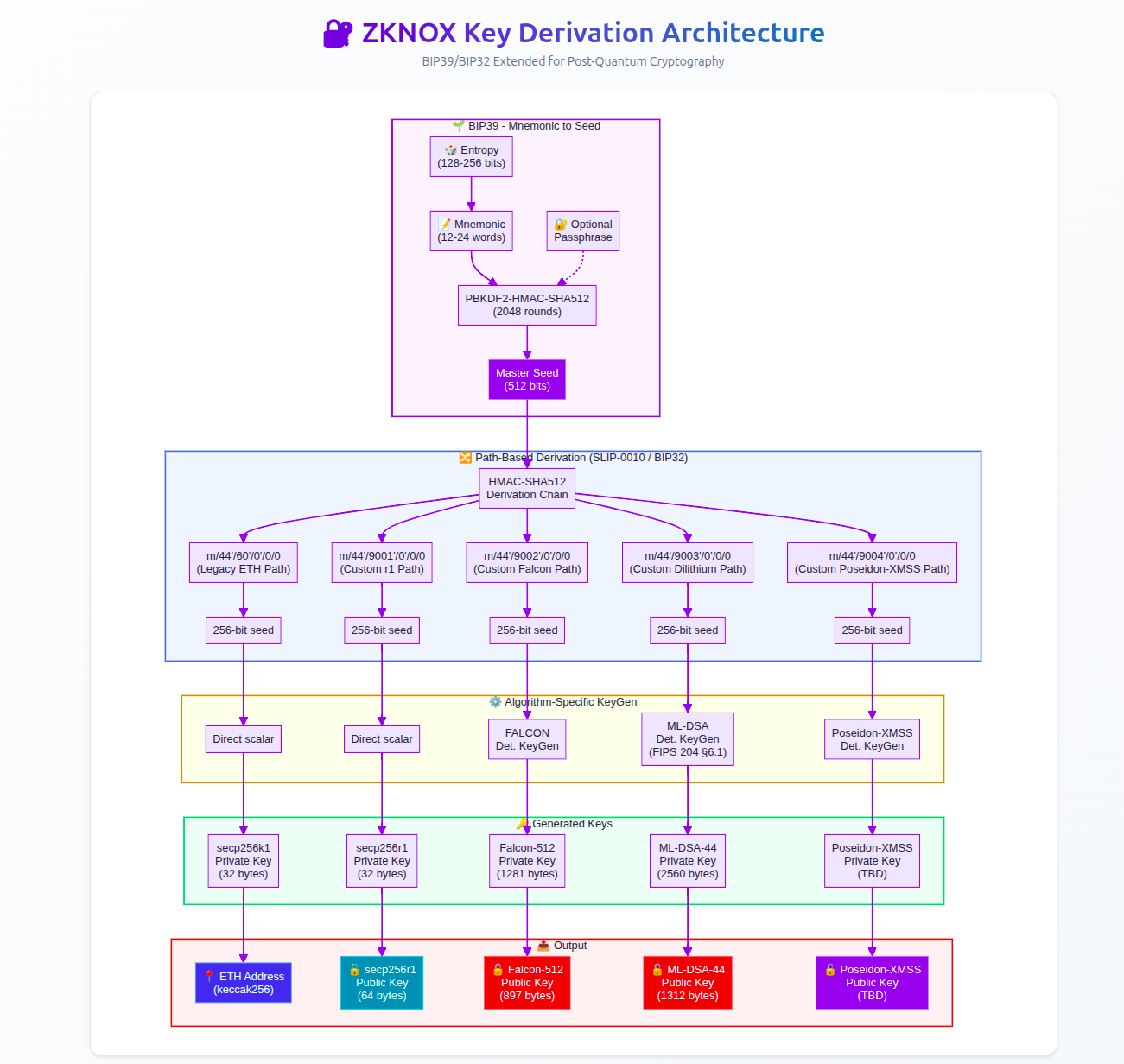
(ZKNOX Key Derivation Standard for PQC)
The concept of ZK-based key migration for frozen accounts has been described by Vitalik Buterin. The mechanism is elegant: users don’t need to pre-register anything. They simply keep their BIP39 seed phrase. After a freeze of legacy EOAs, recovery works by submitting a ZK proof demonstrating knowledge of the master seed that generated both the legacy ETH address AND a new PQ public key. The proof links the old identity to the new key without revealing the secret. To date, however, no production implementation of this recovery mechanism exists.
The following diagram illustrates the circuit related to the ZK-BIP39 proof.
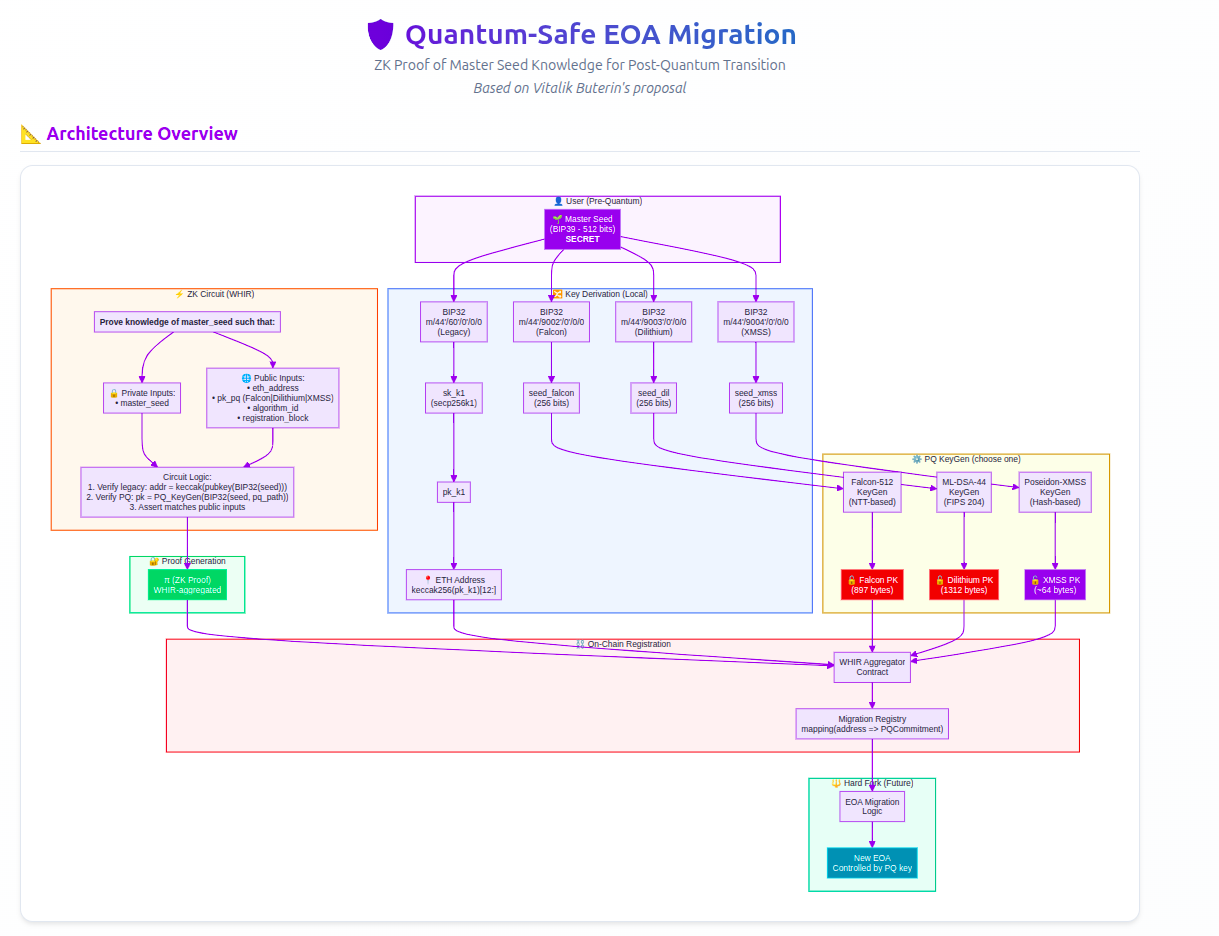
(ZK Based Key Migration)
Piece of Cake (Easy Mode): The Smooth Migration
| Stage 4 reached before CRQC |
✅ None |
$0 |

(The world is cute when everything goes fine)
In this optimistic scenario, the cryptographic community provides sufficient warning — perhaps a decade or more — before cryptographically relevant quantum computers (CRQCs) emerge. Users, DeFi protocols, and infrastructure providers have ample time to migrate.
What happens:
Stage 1 → 2: PQ signature verification is added to the EVM via new precompiles (EIPs for ML-DSA, Falcon, and hash-based signatures)
Stage 2 → 3: ZK-recovery mechanisms are deployed and tested; freeze capability is ready but unused
Stage 3 → 4: Consensus layer migrates from BLS12-381 to PQ aggregatable signatures
Wallet vendors roll out firmware updates supporting PQ key derivation from existing seed phrases
Users upgrade their EOAs to smart accounts with PQ verification
DeFi protocols update their signature verification logic
L2s and bridges implement PQ-compatible verification
The timeline is comfortable: perhaps 2-3 years for protocol changes, another 2-3 years for ecosystem adoption, all completed well before any quantum threat materializes.
User experience: Seamless. A wallet notification prompts upgrade, user confirms, and their account is now quantum-resistant, still controlled by the same seed phrase.
Stage impact on actors:
| Ethereum L1 |
Stage 0 |
Stage 4 |
Precompiles → ZK-recovery → CL migration |
| Major L2s |
Stage 0 |
Stage 3+ |
Inherit L1 precompiles, add PQ sequencer keys |
| Ledger/Trezor |
Stage 0 |
Stage 2+ |
Firmware update with PQ key derivation |
| Uniswap/Aave |
Stage 0 |
Stage 2 |
Accept PQ smart accounts as signers |
| Bridges |
Stage 0 |
Stage 2 |
PQ multisig implementations |
This is the scenario everyone hopes for. It requires no emergency measures, no frozen funds, no losses.
Let’s Rock (Normal Mode): Quantum Computing Accelerates
| Stage 3 reached before CRQC |
⚠️ Moderate |
$1-5B (dormant wallets) |

(Let’s be cautious)
In this scenario, quantum computing progress outpaces initial estimates, but the community responds in time. Strong signals, perhaps a demonstration of Shor’s algorithm on increasingly large key sizes, trigger coordinated action.
What happens:
Most sophisticated users (whales, institutions, active DeFi participants) have migrated to Stage 1-2 PQ accounts before the threat becomes imminent
Major DeFi protocols are at Stage 1+ (accepting PQ smart accounts)
Ethereum L1 has reached Stage 3 — ZK-recovery is operational, freeze mechanism is ready
The community, seeing clear warning signs, achieves rough consensus on an EOA freeze date
A hard fork freezes legacy secp256k1-based EOAs
Stage requirements at freeze time:
| Ethereum L1 |
Stage 3 |
ZK-recovery + freeze operational |
| Wallets |
Stage 2+ |
Can generate ZK proofs from seed |
| DeFi protocols |
Stage 1+ |
Accept PQ smart accounts |
| Users (active) |
Stage 1+ |
Already migrated |
| Users (dormant) |
Stage 0 |
Must use ZK-recovery |
Post-freeze recovery:
The ZK recovery mechanism activates. Users with frozen accounts can recover by generating a WHIR-aggregated proof locally (using their seed phrase) and submitting it alongside their new PQ public key. The proof demonstrates: “I know the seed that generated this frozen address, and here’s my new PQ key derived from the same seed.”
Wallet vendor support: Hardware and software wallet vendors ship “recovery mode” firmware (requires Stage 2 capability). The user connects their device, enters their seed phrase (or it’s already stored securely), and the wallet generates the witness data for the ZK prover. The UX could be as simple as: “Your account was frozen for quantum security. Click here to recover with your new quantum-resistant key.”
Economic assumption: The cost of mounting a Shor attack (requiring a fault-tolerant quantum computer with thousands of logical qubits) exceeds the value of most individual wallets. Attackers would target the largest honeypots first, giving smaller holders time to recover.
Losses: Minimal. Some long-lost wallets (Satoshi-era ETH, forgotten accounts stuck at Stage 0) remain frozen forever, their owners either lost their seeds or are unreachable. But active economic participants recover successfully.
Come Get Some Losses (Hard Mode): Wow, Didn’t See It That Fast
| Stage 1-2 (incomplete Stage 3) |
🔴 Severe |
$20-40B+ |

(That was close)
In this scenario, the transition is underway but incomplete when quantum capabilities arrive. Stage 3 hasn’t been reached — no operational freeze/recovery mechanism. Some major actors are caught exposed.
Ecosystem state at CRQC arrival:
| Ethereum L1 |
Stage 2 |
Precompiles deployed, no freeze mechanism |
| Early adopters |
Stage 1-2 |
Safe (migrated to PQ accounts) |
| Most users |
Stage 0 |
🔴 Exposed pubkeys vulnerable |
| DeFi protocols |
Stage 0-1 |
Mixed — some accept PQ, most don’t |
| Validators |
Stage 0 |
🔴 BLS keys compromised |
What happens: - A cryptographically relevant quantum computer is demonstrated or credibly rumored - Panic ensues; sophisticated attackers (nation-states, well-funded groups) begin targeting high-value addresses - The public keys of any address that has ever sent a transaction are now vulnerable — attackers can derive private keys from exposed public keys
Immediate damage assessment:
| ETH in EOAs with exposed pubkeys |
~70% of all EOA-held ETH |
Stage 1+ migration |
| Top 100 non-contract addresses |
~$10-15B |
Stage 1+ migration |
| DeFi protocol treasuries (EOA-held) |
~$2-5B |
Stage 1 protocol upgrade |
| Bridge hot wallets |
~$1-3B |
Stage 1+ multisig upgrade |
| CEX hot wallets |
~$5-10B |
Internal PQ migration |
Total potential loss: $20-40B+ in immediate exposure, assuming current (2024-2025) valuations.
Emergency response without Stage 3: - Centralized stablecoins freeze: Tether (USDT) and Circle (USDC) have admin keys capable of blacklisting addresses. They freeze all movement pending resolution. This contains ~$100B+ in value but requires trusting centralized actors. - CEX circuit breakers: Major exchanges halt withdrawals and deposits. - Emergency Stage 3 deployment: Rushed implementation of freeze mechanism — high risk of bugs - Rollback debate: The community faces an agonizing choice, roll back the chain to before the attacks, losing potentially days or weeks of legitimate transactions, or accept the losses and move forward.
The rollback calculus: A rollback is technically possible but socially catastrophic. It would:
Destroy confidence in Ethereum’s immutability
Create legal chaos (which transactions are “real”?)
Set a precedent for future interventions
Potentially split the community (those who lost funds vs. those who benefited from legitimate post-attack transactions)
The 2016 DAO hack rollback worked because the community was smaller and the damage was contained. A quantum attack could be far more distributed and harder to cleanly separate from legitimate activity.
Likely outcome: A messy compromise, partial freezes, emergency hard fork to disable secp256k1, rapid deployment of ZK recovery (rushed Stage 3), and significant but not total losses. Some whales get rekt. Trust is damaged but Ethereum survives.
Damn I’m (not) Good (Nightmare Mode): We Are So Rekt
| Stage 0-1 (no preparation) |
💀 Catastrophic |
$100B+ / Chain survival at risk |

(REKT)
In this scenario, quantum computing is available tomorrow. No warning. No preparation complete. Shor’s algorithm runs on a machine that can break secp256k1 in hours or days.
Ecosystem state: Almost entirely Stage 0
| Ethereum L1 |
Stage 0 |
No precompiles, no freeze, no recovery |
| L2s |
Stage 0 |
ECDSA-only |
| Wallets |
Stage 0 |
No PQ support |
| DeFi |
Stage 0 |
EOA-only governance |
| Validators |
Stage 0 |
BLS12-381 compromised |
| ZKNOX users |
Stage 1 |
🟢 Only survivors with self-custody |
Immediate impact:
Every EOA with an exposed public key is vulnerable
Every validator’s BLS signature is compromised (BLS12-381 also falls to quantum attacks)
Consensus itself is at risk
Emergency possibilities:
1. Centralized Currency Freeze
USDT, USDC, and other centralized stablecoins can freeze all transfers via admin functions. These issuers would wait until a recovery mechanism is designed, then selectively unfreeze based on proof of legitimate ownership.
2. Naive Consensus Fallback (Stage 4 emergency improvisation)
A hastily-deployed consensus mechanism where each validator signs using a PQ signature (e.g., Dilithium) before BLS aggregation could theoretically work, but the performance impact would be severe:
Current BLS aggregation: - Signature size: 96 bytes (aggregated from all attesters)
- Verification: Single pairing check, ~1-2ms
Naive PQ replacement (FALCON512):
Signature size: 666 bytes × ~300,000 validators = ~200MB per epoch just for attestations
Verification: Each signature verified individually, ~0.5ms × 300,000 = ~150 seconds per epoch
This is obviously unworkable for normal operation. The network would grind to a halt or require massive validator set reduction (e.g., only 1,000 validators, re-introducing centralization), or some recursion.
A more realistic emergency consensus:
Dramatically reduce validator count to a trusted emergency set
Accept centralization as temporary survival mode
Block times increase from 12 seconds to perhaps minutes
3. ERC-4337 Account Abstraction Refuge (Stage 1 lifeboats)
Users with existing 4337 smart accounts using PQ verification (like ZKNOX accounts) would be the only ones with secure, self-custodial access. These Stage 1 accounts become lifeboats. However, if the underlying L1 consensus is compromised, even these accounts are only as secure as the chain they’re on.
4. L2 Evacuation
If L2s can quickly deploy PQ verification (emergency Stage 1) and their sequencers aren’t compromised, they might serve as temporary safe havens. Assets could be bridged to L2s that implement emergency PQ measures faster than L1 can hard fork.
Realistic outcome: Catastrophic even if not terminal. Ethereum would survive in a very diminished, emergency form. Massive value destruction occurs. Recovery takes months or years. The “immutable ledger” narrative is permanently damaged, but the technology eventually rebuilds with proper quantum resistance.
Summary: Scenarios vs. Required Stages
| Piece of Cake |
Easy |
Stage 4 |
5-10 years |
$0 |
| Let’s Rock |
Normal |
Stage 3 |
2-5 years |
$1-5B (dormant) |
| Come Get Some |
Hard |
Stage 2 (incomplete 3) |
1-2 years |
$20-40B |
| Damn I’m Good |
Nightmare |
Stage 0-1 |
0 (too late) |
$100B+ |

(Where are we? Where do we need to be?)
Conclusion
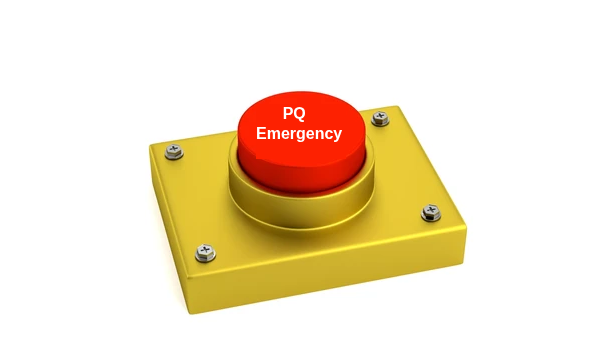
(We need a red button .)
A kill switch is required, not to use, hopefully never to use, but to have ready as a mitigation against the nightmare scenario. In PQBeat terms: we need Stage 3 readiness as insurance, even if we hope to reach Stage 4 gracefully.
This means:
Stage 3 minimum: Implemented ZK recovery circuits, tested and audited, ready for emergency deployment
WHIR aggregation infrastructure that can handle mass recovery operations
Wallet vendor integration (Stage 2) so recovery UX is ready, not improvised
Emergency consensus specifications (Stage 4 fallback) that trade decentralization for survival
Coordination mechanisms between major stakeholders (client teams, large stakers, centralized issuers) for rapid response
The cost of building this infrastructure is trivial compared to the potential losses. Even if the probability of a nightmare scenario is low, the expected value calculation clearly favors preparation:
$4Mpreparation ≪ 0.1% × $40Bloss = $400Mexpected_loss
The Nuke may never come, or may come so slowly we barely notice the transition. But if it comes fast, we need to be ready.
Track progress at pqbeat.zknox.com. Keep your seed phrase safe. It may be your only recovery path.
(Quantum Apocalypse Clock is ticking)
References
Post-Quantum Readiness in EdDSA Chains
How to hard-fork to save most users’ funds in a quantum emergency
PQBeat - Post-Quantum Readiness Tracker
Reach us
🔐 Practical security on the whole chain.
Github | Website | Twitter | Blog | Contact Info
Found typo, or want to improve the note ? Our blog is open to PRs.
ZKNOX — Post-Quantum Cryptography for Ethereum
Scenarios for Post-Quantum Migrations
2026 Feb 11 See all postsA meme in the cryptographic domain is “Cryptography is easy, Key Management is hard”. While current efforts to bring Ethereum to the Post-Quantum Era are underway, deployment will still take years. This post does not venture to make any bet or commitment on which scenario is most probable for which deadline. But first, let’s examine how to handle a risk.
Basically, risk resource allocation follows:
risk_materialization_cost × risk_probability = resource_allocation
Looking at today’s risk management in the Ethereum ecosystem, it seems to be handled more as a binary ‘0/1’ problem, either quantum computers are a threat or they aren’t. There’s no widely accepted model to extrapolate quantum computing progress, making probabilistic planning difficult. What we can do is prepare for multiple scenarios. First let’s have a look at the exposure:
This post explores various scenarios of key migration in the face of the Quantum Computing Nuke.
(Now pick your difficulty level)
PQBeat Readiness Stages
Before diving into scenarios, let’s define the PQBeat stages that measure an ecosystem’s post-quantum readiness. These stages are tracked at pqbeat.zknox.com.
L1/L2 Chain Stages
Wallets & Protocols
Wallets and protocols inherit the stage of their deployment chain when they support PQ smart accounts:
The Current Efforts
The Ethereum community is actively working on post-quantum migration strategies. The emerging consensus points toward a layered approach: aggregating PQ signatures into Post-Quantum SNARKs (specifically STARK or WHIR-based proofs) to manage the significant size overhead of PQ signatures on-chain.
Several concrete implementations already exist. Post-Quantum Smart Accounts based on ERC-4337 have been developed, notably hash-based schemes like XMSS with ZK-friendly Poseidon hashing and ZKNOX’s implementation supporting Falcon, Dilithium (ML-DSA). These allow users to transition to quantum-resistant security today, without waiting for protocol-level changes.
The key derivation architecture would extend BIP32/BIP39 with new derivation paths for each PQ algorithm, using the same master seed to derive both legacy secp256k1 keys and new PQ keys (Falcon at
m/44'/9002'/..., Dilithium atm/44'/9003'/..., etc.). The following diagram illustrates the foresight mechanism, adapted to the ZKNOX Post Quantum key derivation scheme.(ZKNOX Key Derivation Standard for PQC)
The concept of ZK-based key migration for frozen accounts has been described by Vitalik Buterin. The mechanism is elegant: users don’t need to pre-register anything. They simply keep their BIP39 seed phrase. After a freeze of legacy EOAs, recovery works by submitting a ZK proof demonstrating knowledge of the master seed that generated both the legacy ETH address AND a new PQ public key. The proof links the old identity to the new key without revealing the secret. To date, however, no production implementation of this recovery mechanism exists.
The following diagram illustrates the circuit related to the ZK-BIP39 proof.
(ZK Based Key Migration)
Piece of Cake (Easy Mode): The Smooth Migration
(The world is cute when everything goes fine)
In this optimistic scenario, the cryptographic community provides sufficient warning — perhaps a decade or more — before cryptographically relevant quantum computers (CRQCs) emerge. Users, DeFi protocols, and infrastructure providers have ample time to migrate.
What happens:
Stage 1 → 2: PQ signature verification is added to the EVM via new precompiles (EIPs for ML-DSA, Falcon, and hash-based signatures)
Stage 2 → 3: ZK-recovery mechanisms are deployed and tested; freeze capability is ready but unused
Stage 3 → 4: Consensus layer migrates from BLS12-381 to PQ aggregatable signatures
Wallet vendors roll out firmware updates supporting PQ key derivation from existing seed phrases
Users upgrade their EOAs to smart accounts with PQ verification
DeFi protocols update their signature verification logic
L2s and bridges implement PQ-compatible verification
The timeline is comfortable: perhaps 2-3 years for protocol changes, another 2-3 years for ecosystem adoption, all completed well before any quantum threat materializes.
User experience: Seamless. A wallet notification prompts upgrade, user confirms, and their account is now quantum-resistant, still controlled by the same seed phrase.
Stage impact on actors:
This is the scenario everyone hopes for. It requires no emergency measures, no frozen funds, no losses.
Let’s Rock (Normal Mode): Quantum Computing Accelerates
(Let’s be cautious)
In this scenario, quantum computing progress outpaces initial estimates, but the community responds in time. Strong signals, perhaps a demonstration of Shor’s algorithm on increasingly large key sizes, trigger coordinated action.
What happens:
Most sophisticated users (whales, institutions, active DeFi participants) have migrated to Stage 1-2 PQ accounts before the threat becomes imminent
Major DeFi protocols are at Stage 1+ (accepting PQ smart accounts)
Ethereum L1 has reached Stage 3 — ZK-recovery is operational, freeze mechanism is ready
The community, seeing clear warning signs, achieves rough consensus on an EOA freeze date
A hard fork freezes legacy secp256k1-based EOAs
Stage requirements at freeze time:
Post-freeze recovery:
The ZK recovery mechanism activates. Users with frozen accounts can recover by generating a WHIR-aggregated proof locally (using their seed phrase) and submitting it alongside their new PQ public key. The proof demonstrates: “I know the seed that generated this frozen address, and here’s my new PQ key derived from the same seed.”
Wallet vendor support: Hardware and software wallet vendors ship “recovery mode” firmware (requires Stage 2 capability). The user connects their device, enters their seed phrase (or it’s already stored securely), and the wallet generates the witness data for the ZK prover. The UX could be as simple as: “Your account was frozen for quantum security. Click here to recover with your new quantum-resistant key.”
Economic assumption: The cost of mounting a Shor attack (requiring a fault-tolerant quantum computer with thousands of logical qubits) exceeds the value of most individual wallets. Attackers would target the largest honeypots first, giving smaller holders time to recover.
Losses: Minimal. Some long-lost wallets (Satoshi-era ETH, forgotten accounts stuck at Stage 0) remain frozen forever, their owners either lost their seeds or are unreachable. But active economic participants recover successfully.
Come Get Some Losses (Hard Mode): Wow, Didn’t See It That Fast
(That was close)
In this scenario, the transition is underway but incomplete when quantum capabilities arrive. Stage 3 hasn’t been reached — no operational freeze/recovery mechanism. Some major actors are caught exposed.
Ecosystem state at CRQC arrival:
What happens: - A cryptographically relevant quantum computer is demonstrated or credibly rumored - Panic ensues; sophisticated attackers (nation-states, well-funded groups) begin targeting high-value addresses - The public keys of any address that has ever sent a transaction are now vulnerable — attackers can derive private keys from exposed public keys
Immediate damage assessment:
Total potential loss: $20-40B+ in immediate exposure, assuming current (2024-2025) valuations.
Emergency response without Stage 3: - Centralized stablecoins freeze: Tether (USDT) and Circle (USDC) have admin keys capable of blacklisting addresses. They freeze all movement pending resolution. This contains ~$100B+ in value but requires trusting centralized actors. - CEX circuit breakers: Major exchanges halt withdrawals and deposits. - Emergency Stage 3 deployment: Rushed implementation of freeze mechanism — high risk of bugs - Rollback debate: The community faces an agonizing choice, roll back the chain to before the attacks, losing potentially days or weeks of legitimate transactions, or accept the losses and move forward.
The rollback calculus: A rollback is technically possible but socially catastrophic. It would:
Destroy confidence in Ethereum’s immutability
Create legal chaos (which transactions are “real”?)
Set a precedent for future interventions
Potentially split the community (those who lost funds vs. those who benefited from legitimate post-attack transactions)
The 2016 DAO hack rollback worked because the community was smaller and the damage was contained. A quantum attack could be far more distributed and harder to cleanly separate from legitimate activity.
Likely outcome: A messy compromise, partial freezes, emergency hard fork to disable secp256k1, rapid deployment of ZK recovery (rushed Stage 3), and significant but not total losses. Some whales get rekt. Trust is damaged but Ethereum survives.
Damn I’m (not) Good (Nightmare Mode): We Are So Rekt
(REKT)
In this scenario, quantum computing is available tomorrow. No warning. No preparation complete. Shor’s algorithm runs on a machine that can break secp256k1 in hours or days.
Ecosystem state: Almost entirely Stage 0
Immediate impact:
Every EOA with an exposed public key is vulnerable
Every validator’s BLS signature is compromised (BLS12-381 also falls to quantum attacks)
Consensus itself is at risk
Emergency possibilities:
1. Centralized Currency Freeze
USDT, USDC, and other centralized stablecoins can freeze all transfers via admin functions. These issuers would wait until a recovery mechanism is designed, then selectively unfreeze based on proof of legitimate ownership.
2. Naive Consensus Fallback (Stage 4 emergency improvisation)
A hastily-deployed consensus mechanism where each validator signs using a PQ signature (e.g., Dilithium) before BLS aggregation could theoretically work, but the performance impact would be severe:
Current BLS aggregation: - Signature size: 96 bytes (aggregated from all attesters)
Naive PQ replacement (FALCON512):
Signature size: 666 bytes × ~300,000 validators = ~200MB per epoch just for attestations
Verification: Each signature verified individually, ~0.5ms × 300,000 = ~150 seconds per epoch
This is obviously unworkable for normal operation. The network would grind to a halt or require massive validator set reduction (e.g., only 1,000 validators, re-introducing centralization), or some recursion.
A more realistic emergency consensus:
Dramatically reduce validator count to a trusted emergency set
Accept centralization as temporary survival mode
Block times increase from 12 seconds to perhaps minutes
3. ERC-4337 Account Abstraction Refuge (Stage 1 lifeboats)
Users with existing 4337 smart accounts using PQ verification (like ZKNOX accounts) would be the only ones with secure, self-custodial access. These Stage 1 accounts become lifeboats. However, if the underlying L1 consensus is compromised, even these accounts are only as secure as the chain they’re on.
4. L2 Evacuation
If L2s can quickly deploy PQ verification (emergency Stage 1) and their sequencers aren’t compromised, they might serve as temporary safe havens. Assets could be bridged to L2s that implement emergency PQ measures faster than L1 can hard fork.
Realistic outcome: Catastrophic even if not terminal. Ethereum would survive in a very diminished, emergency form. Massive value destruction occurs. Recovery takes months or years. The “immutable ledger” narrative is permanently damaged, but the technology eventually rebuilds with proper quantum resistance.
Summary: Scenarios vs. Required Stages
(Where are we? Where do we need to be?)
Conclusion
(We need a red button .)
A kill switch is required, not to use, hopefully never to use, but to have ready as a mitigation against the nightmare scenario. In PQBeat terms: we need Stage 3 readiness as insurance, even if we hope to reach Stage 4 gracefully.
This means:
Stage 3 minimum: Implemented ZK recovery circuits, tested and audited, ready for emergency deployment
WHIR aggregation infrastructure that can handle mass recovery operations
Wallet vendor integration (Stage 2) so recovery UX is ready, not improvised
Emergency consensus specifications (Stage 4 fallback) that trade decentralization for survival
Coordination mechanisms between major stakeholders (client teams, large stakers, centralized issuers) for rapid response
The cost of building this infrastructure is trivial compared to the potential losses. Even if the probability of a nightmare scenario is low, the expected value calculation clearly favors preparation:
$4Mpreparation ≪ 0.1% × $40Bloss = $400Mexpected_loss
The Nuke may never come, or may come so slowly we barely notice the transition. But if it comes fast, we need to be ready.
Track progress at pqbeat.zknox.com. Keep your seed phrase safe. It may be your only recovery path.
(Quantum Apocalypse Clock is ticking)
References
Post-Quantum Readiness in EdDSA Chains
How to hard-fork to save most users’ funds in a quantum emergency
PQBeat - Post-Quantum Readiness Tracker
Reach us
🔐 Practical security on the whole chain.
Github | Website | Twitter | Blog | Contact Info
Found typo, or want to improve the note ? Our blog is open to PRs.
ZKNOX — Post-Quantum Cryptography for Ethereum